
A chief technology officer (CTO) is a top executive who leads tech strategy, drives new ideas, and links tech spending to business goals. The best CTOs blend deep tech skills with strong leadership, earning six-figure pay while shaping how companies across every industry use technology.
Technology now plays a key role in daily business work. The CTO guides tech use and new ideas across all fields. CTOs find, test, and roll out new tools that help their companies stand out. They also plan and invest in tech that serves customers and drives growth.
The CTO role grew out of the chief information officer (CIO) role. In the past, the CIO did the work of both roles. But tech growth made it necessary to split them. Today, the CTO focuses on tools and products that reach customers. The CIO manages internal systems and daily IT work.
CTOs come from many backgrounds. There is no single path to this role. No one degree gets you there. Most CTOs took on bigger tech roles over time. They built the skills and know-how to succeed. To become a CTO, you need tech skills, leadership, and a clear vision. This often means hands-on work, constant learning, and a grasp of both tech and business.
As a C-level leader, the CTO holds a top-tier role. They align tech with business goals and push new ideas forward. CTOs must also show business leaders the value of tech. This builds support for tech projects.
CTOs guide tech use and new ideas. They build and carry out tech plans that match company goals.
We took a deep look at the CTO role. We wanted to learn what sets a great CTO apart. Staying on top of tech trends is key for CTOs who want an edge. We explore the paths to become a CTO, pay data, and other key facts.
Read on to learn about the schooling, skills, and work of top CTOs. We cover where they studied, what they studied, top employers, pay ranges, and more.
An Overview of Chief Technology Officers
The CTO looks at a company's tech needs, problems, and chances to grow. They find gaps and spot ways to boost speed and results through tech.
CTOs are also called chief technical officers or chief technologists. The CTO most often reports to the CEO or other top leaders. In some cases, they report to the CIO. This line of reporting shapes their clout in the leadership team. The CTO is the highest technology executive role in a company. They run the IT or engineering team. They find ways to use tech to make products or services better for customers. They also build plans to grow revenue. They look at the ROI of new tools that reach customers. The CTO creates and runs a tech plan that fits the company's goals. This helps tech projects drive long-term success.
The core duties of a CTO are the key tasks tied to this top role. The best CTOs have a wide set of skills. These include leadership, project work, product building, IT management, and software design. It is a high-paying role, with average pay in the six-figure range. It is also a fulfilling role. Payscaley)y) gives the CTO role a 4.2 out of 5 job rating. This is based on 287 responses and shows most CTOs enjoy their work.
Job descriptions for CTO roles often list these technical skills:
-
Information security management.
-
Cybersecurity.
-
Big data engineering.
-
Network architecture.
-
Artificial intelligence and machine learning.
-
Software development.
But CTOs need more than tech skills. Job posts often list these business and management skills as well:
-
Statistics.
-
Analytics and research.
-
Marketing.
-
Finance, economics, and budgets.
-
Strong people skills.
-
Leadership.
-
Big-picture thinking.
-
Fresh ideas.
-
Ability to adapt.
-
Strong planning skills.
-
Deal-making skills.
-
Ability to work under pressure and meet deadlines.
Educational Background and Work Experience
The CTO is a tech-focused role. Most people work their way up before they get it. Many CTOs hold degrees in fields like IT, computer science, software, or cybersecurity. A bachelor's degree in a related field is the most common starting point.
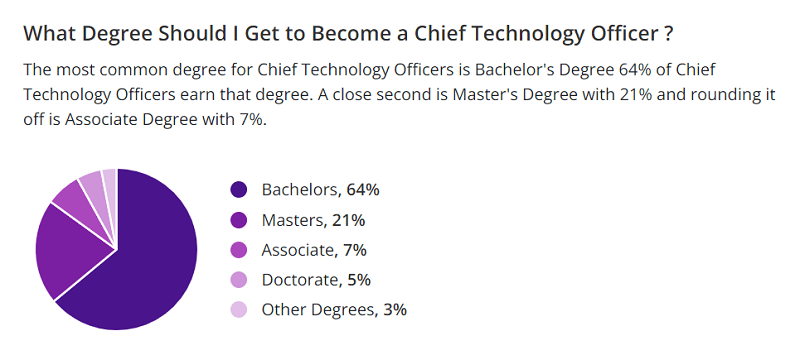
Screenshot via Zippia
According to Zippia, a bachelor's degree is the most common among CTOs. About one in five hold a master's degree:
-
Bachelor's: 64%.
-
Master's: 21%.
-
Associate: 7%.
-
Doctorate: 5%.
-
Other Degrees: 3%.
Many firms want CTO candidates with a master's degree. This could be an MBA or a master's in tech, computer science, or IT. A master's degree gives a clear edge. It builds a stronger base in business and management. Bachelor's degrees focus more on basics like math, coding, and software. Some employers accept work experience in place of a master's degree. Certifications can also help.
CTOs are C-level leaders with deep work experience. The Bureau of Labor Statistics says many employers want 15 or more years of experience. The exact number varies by industry, company size, and location. Smaller firms may ask for less but pay less. Large companies seek the most proven talent. Most CTOs start in roles like tech support, software, or systems work. They gain hands-on skills as they rise to the top. The job outlook for CTOs is strong. Growth comes from digital shifts and the need for better cybersecurity.
CTOs are vital in tech-heavy fields. These include automation, cybersecurity, data, AI, and digital tools. Tech leadership drives progress in these areas.
Crunchbase News looked at its data to find the top schools among funded startup CTOs. They checked U.S. colleges attended by CTOs whose startups raised $500,000 or more from 2017 to 2019. They found that "CTOs are much more likely to graduate from technical universities and other schools renowned for their engineering and computer science departments." The top 20 schools for CTOs at funded startups include:
-
Stanford.
-
MIT.
-
UC Berkeley.
-
Carnegie Mellon.
-
Cornell.
-
University of Illinois - Urbana-Champaign.
-
Harvard.
-
University of Michigan.
-
UT Austin.
-
University of Washington.
-
Columbia.
-
USC.
-
Penn.
-
Georgia Tech.
-
Princeton.
-
UCLA.
-
Caltech.
-
UC San Diego.
-
Northwestern.
-
Yale.
The list has some Ivy League schools along with smaller and state schools. Keep in mind this ranking only covers funded startup CTOs. Most CTOs work at larger, older companies.
The school matters less than what you study and your work history. Per Zippia, the best majors for future CTOs include:
-
Computer Science.
-
Electrical Engineering.
-
Business.
-
Computer Engineering.
-
Computer Information Systems.
-
Information Technology.
-
Mechanical Engineering.
-
Physics.
-
Mathematics.
-
Chemistry.
-
Management.
-
Management Information Systems.
-
Finance.
-
Engineering.
-
Information Systems.
-
Economics.
-
Accounting.
-
Communication.
-
Psychology.
-
Political Science.
To succeed as a CTO, you need strong skills in both tech and business. This lets you link tech plans with company goals.
Zippia also lists the top schools where CTOs on the site went to school. These include:
-
University of Maryland - College Park: 9.42%.
-
University of Phoenix: 7.99%.
-
New York University: 6.20%.
-
University of Texas at Austin: 5.84%.
-
Massachusetts Institute of Technology: 5.84%.
Here are some fields of study that can put you on a path to becoming a CTO. To stay ahead, CTOs must keep up with tech trends and new tools.
Computer Science & Computer Information Systems
Most colleges offer a basic computer science degree along with other tech programs. Degrees in this area come in many forms. A few programs to look at include:
-
Stanford University - Undergraduate Major in Computer Science.
-
University of Illinois Urbana-Champaign - Undergraduate Computer Science Degree & Program Options.
-
University of Pittsburgh - Computer Information Systems and Technology - BS.
Information Technology
IT is another field that overlaps with computer science degrees. Many top schools offer good programs in this area. Here are a few:
-
University of Washington - The Information School Undergraduate Programs.
-
Cal State LA - Department of Information Systems Undergraduate Programs.
-
University of Pennsylvania - Operations, Information & Decisions Department Undergraduate Program.
-
Caltech - Undergraduate Major in Information and Data Sciences.
-
University of Michigan - Flint - Bachelor of Science in Information Technology & Informatics.
-
Cornell - BS in Information Science, Systems, and Technology, (ISST).
-
University of Texas at Dallas - Bachelor of Science in Information Technology and Systems.
Electrical/Computer Engineering
Some schools offer combined majors in computer science and electrical engineering. These are great picks for future CTOs. Stand-alone programs in either field work well too. Here are a few options:
-
MIT - Electrical Engineering and Computer Science Undergraduate Program.
-
UC Berkeley - Electrical Engineering and Computer Science Bachelor of Science.
-
University of Illinois Urbana-Champaign - Electrical Engineering.
-
Cornell - Electrical and Computer Engineering Undergraduate Programs.
-
Carnegie Mellon University - Electrical and Computer Engineering.
-
University of Maryland College Park - B.S. in Electrical Engineering.
-
Stanford - Bachelor of Science (B.S.), Electrical Engineering.
-
New York University - Electrical Engineering and Computer Engineering, B.S..
A business degree is a flexible choice that opens many career paths. CTOs with business degrees may want to add tech graduate degrees or certifications. Hands-on field experience also helps. Business degrees come in many forms. Here are a few:
-
Penn State - Management Information Systems Undergraduate Degree.
-
Northwestern - Industrial Engineering and Management Sciences Undergraduate Program.
-
Ohio State University - Bachelor of Science in Business Administration.
-
University of Pittsburgh - Business Information Systems Major.
Salary Information for Successful CTOs in Technology Strategy
CTO salaries depend on several factors, including:
-
Education.
-
Years of relevant experience.
-
Geographic location.
-
Industry.
-
Certifications.
-
Additional skills.
CTO jobs are in high demand. They offer strong pay and a good job outlook. The need for CTOs will keep growing as companies focus on tech, digital shifts, and cybersecurity.
Pay data varies by source. Glassdoor's data comes from 563 CTO pay reports. Indeed's comes from 259 reports. These may not cover all CTOs. Still, they give a clear picture of what CTOs can earn.
Per Glassdoor's data, CTOs earn an average base of $191,126 per year in the U.S. The range is $113,000 to $322,000. Indeed puts the average at $164,350 plus $20,000 in profit sharing.
Payscaley) reports a base of $164,350 based on 2,350 profiles. The range is $90,000 to $248,000. Bonuses and profit sharing push total pay to $91,000 to $297,000. Salary.com puts the median at $254,308. The typical range is $213,268 to $297,448.
Let's look at how these factors affect a CTO's pay.
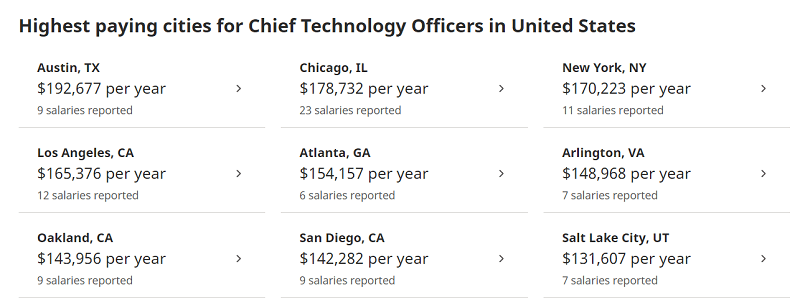
Screenshot via Indeed
The cost of living in an area affects pay. Local market factors matter too. In tech hubs like Silicon Valley, more firms compete for good CTOs. The best way to draw top talent is with higher pay. CTOs in big cities tend to earn more than the national average. Living costs are higher there. There is also more competition for the best CTOs.
Indeed reports the highest paying cities for CTOs in the U.S.:
-
Austin, TX: $192,677/year based on 9 reported salaries.
-
Chicago, IL: $178,732/year based on 23 reported salaries.
-
New York, NY: $170,223/year based on 11 reported salaries.
-
Los Angeles, CA: $165,376/year based on 12 reported salaries.
-
Atlanta, GA: $154,157/year based on 6 reported salaries.
-
Arlington, VA: $148,968/year based on 7 reported salaries.
-
Oakland, CA: $143,956/year based on 9 reported salaries.
-
San Diego, CA: $142,282/year based on 9 reported salaries.
-
Salt Lake City, UT: $131,607/year based on 7 reported salaries.
Payscaley) also shows where CTOs earn the most. CTOs earn 20% or more above the national average in these cities:
-
Waltham, MA: 59%.
-
San Jose, CA: 45%.
-
Ashburn, VA: 45%.
-
San Mateo, CA: 38%.
-
Redwood City, CA: 37%.
-
Hartford, CT: 31%.
-
Redmond, WA: 27%.
-
Boston, MA: 24%.
-
Palo Alto, CA: 22%.
-
White Plains, NY: 22%.
-
Santa Monica, CA: 22%.
-
Bellevue, WA: 22%.
-
Plano, TX: 22%.
-
Sarasota, FL: 22%.
-
Atlanta, GA: 21%.
-
San Francisco, CA: 20%.
-
Lisle, IL: 20%.
-
Philadelphia, PA: 20%.
-
Chicago, IL: 20%.
_Screenshot via Payscaley)_
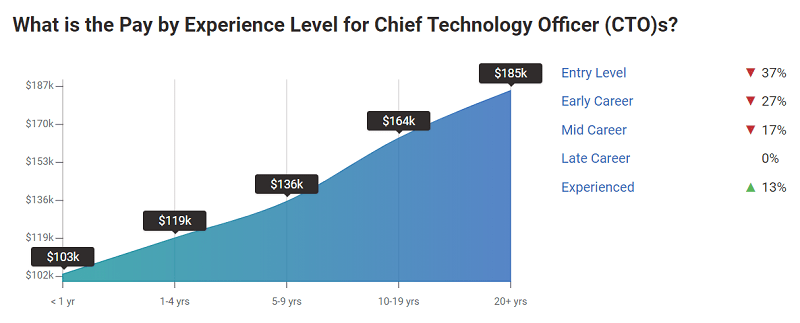
Years of experience also affect CTO pay. Companies may offer more to someone with 15+ years of experience. A first-time CTO may start at a lower base. Education level has a similar effect. Pay seems to peak at the master's level. A CTO with a doctorate may not earn more than one with a master's. In fact, some data shows lower average pay for CTOs with doctorates.
Payscale breaks down average CTO salaries by experience level:
-
Less than 1 year: $103,000.
-
1-4 years: $119,000.
-
5-9 years: $136,000.
-
10-19 years: $164,000.
-
20+ years: $185,000.
And Zippia offers a breakdown by education level:
-
Master's Degree: $172,091.
-
Doctorate Degree: $169,782.
-
Bachelor's Degree: $158,898.
-
Some College/ Associate Degree: $129,778.
Pay is not the only thing people want. Benefits matter too. Per Indeed, CTOs often get perks such as:
-
Stock options.
-
Visa sponsorship.
-
Family and bereavement leave.
-
Gym memberships and massage services.
-
Flexible work schedules.
-
Health insurance.
-
Paid sick leave.
Per Payscaley), medical is the most common health perk for CTOs. Here is how many CTOs report each type:
-
Medical: 85%.
-
Dental: 73%.
-
Vision: 66%.
-
None: 15%.
Employers often seek CTOs with certain skills. These skills can change pay. In the image below, Payscale lists skills that affect CTO pay and the extra amount CTOs with each skill can earn.
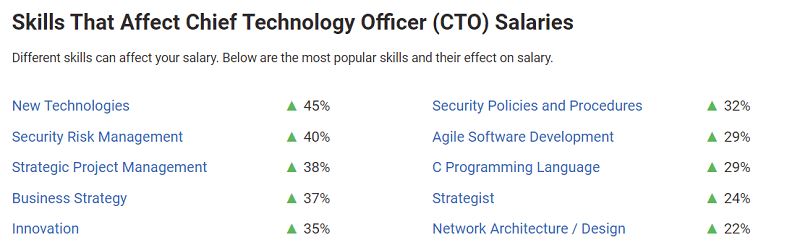
_Screenshot via Payscaley)_
Salary.com is a great tool for CTO pay estimates. You can filter by education, experience, location, team size, and results. It then shows your expected pay and how it stacks up to the national average.
Where Chief Technology Officers Work
Almost every industry uses tech to improve or deliver products. So more companies now have a CTO or a similar role. Smaller firms may have a CIO who does both jobs. Larger firms are more likely to split the roles. At tech companies, the CTO role is key. These firms need tech leaders for new ideas and to stay ahead.
CTOs work for government bodies like the U.S. Department of Defense and the U.S. Air Force. They also work in finance, healthcare, education, media, utilities, and more. Any firm that uses tech for its customers may hire a CTO. CTOs work closely with company leaders. They make sure tech projects match business goals.
In an article published at Forbes, Timour Procopovich says, "Every company looking to implement software solutions needs one tech-savvy person who can make essential decisions around the technological aspects of the software. It's important to have someone on the business's side who understands both the nuanced needs the system should meet and the technological aspects of meeting those needs." The tech team, led by the CTO, builds and manages the tech to meet these needs.
Smaller firms may not have the budget for a full CTO. Some have other leaders who do the CTO's tasks, like a CIO. Others have no one for these choices. Procopovich offers a fix: partner with a software vendor to fill the CTO role. The right vendor can solve some of these gaps. But who picks the vendor? Most often, it is the CTO. The key point is that every company needs a tech-savvy leader or partner. This person makes sure tech spending fits business goals. CIOs manage IT and internal work. CTOs focus on tech that improves products for customers.
Another option is a fractional CTO. A fractional CTO works as a part-time advisor you call on as needed. Many firms hire one first. These experts often help find the right person for a full-time CTO role. If both sides agree, the firm can then hire them full-time.
When spending on tech, CTOs and leaders should review both current and new options. The goal is to boost results and support company aims.
Below are some top firms that hire CTOs. Average pay data comes from Glassdoor or Indeed.
IBM
Average Salary: $265,493/year (11 salaries).
Salary Range: $102K - $513K.

IBM is a major tech company based in Armonk, New York. It works in 171 countries.
Marcus Theatres
Average Salary: $217,218 (10 salaries).
Salary Range: $107K - $376K.

Marcus Theaters is the fourth largest theatre chain in the U.S. It runs 1,106 screens at 91 spots in 17 states under the Marcus, Movie Tavern, and BistroPlex brands.
Explore careers at Marcus Theaters
Average Salary: $255,712/year (8 salaries).
Salary Range: $101K - $738K.
Google is best known for its search engine. It also offers smartphones, Chromebooks, Google Classroom, Google Earth, Google Drive, and much more.
Microsoft
Average Salary: $295,290/year (5 salaries).
Salary Range: $200K - $1M.

Microsoft makes operating systems, hardware, SaaS products, and more. It is "dedicated to advancing human and organizational achievement."
DXC Technology
Average Salary: $245,504/year (4 salaries).
Salary Range: $206K - $273K.
DXC Technology provides "mission-critical IT services that transform global businesses." It helps firms run key systems, upgrade IT, and ensure security across clouds.
Explore careers at DXC Technology
ABC
Average Salary: $205,608/year (3 salaries).
Salary Range: $142K - $295K.

ABC airs popular shows and awards like The Oscars and The Country Music Awards. ABC Studios handles making and sharing content for the ABC Entertainment Group.
Farmer's Fridge
Average Salary: $177,350/year (3 salaries).
Salary Range: $160K - $194K.

Farmer's Fridge "started with a network of smart Fridges, designed to make finding fresh & healthy meals as simple as vending a candy bar." The company also launched a home delivery service during the COVID-19 pandemic. It has delivered hundreds of thousands of meals to 40+ states.
Explore careers at Farmer's Fridge
AFL-CIO
Average Salary: $149,579/year.
The American Federation of Labor and Congress of Industrial Organizations (AFL-CIO) is a "democratic, voluntary federation of 57 national and international labor unions that represent 12.5 million working men and women."
TextUs
Average Salary: About $204K -$218K.

TextUs provides text messaging services for businesses. It helps companies engage with leads, customers, employees, and candidates in real-time.
Wells Fargo
Average Salary: About $261K -$282K.

Wells Fargo is a global bank. It offers personal banking, small business tools, investing, wealth management, and corporate services.
Explore careers at Wells Fargo
Smarsh
Average Salary: About $239K -$407K.
Smarsh provides "future-proof capture, archiving and oversight solutions that help you manage risk and unleash the intelligence in your electronic communications data."
Neurobehavioral Systems
Average Salary: About $201K -$220K.
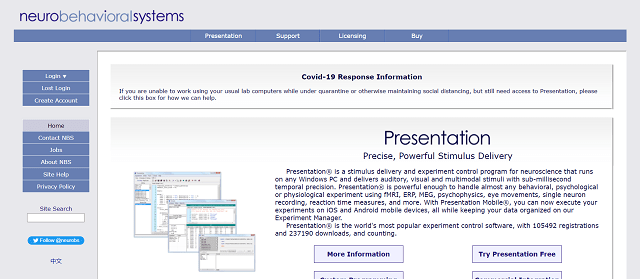
Founded in 2000, this company makes software for behavioral and psychological tests. Its product, Presentation, has "become the premiere platform at research institutions around the world."
Explore careers at Neurobehavioral Systems
Blink Health
Average Salary: About $257K -$279K.

Blink Health is "the digital health company on a mission to make prescriptions more affordable and accessible for everyone."
Explore careers at Blink Health
Hub Technical
Average Salary: About $141K -$153K.

Hub Technical is an IT services firm. It has built tools that provide better services at lower cost for state agencies, towns, and school districts.
Explore careers at Hub Technical
JOOR
Average Salary: About $235K -$261K.

JOOR is a wholesale management platform. It has "digitalized the entire wholesale process--from connection to invoicing--to make the experience smarter and more seamless for both brands and retailers."
Who Are Today's Top CTOs
We spoke with several CTOs. We asked about their schooling, work history, and top skills. We also asked what traits matter most for success in this role.
Swetank Sisodia

LinkedIn: Swetank Sisodia
CTO at Lumiere32 Pte Ltd
Education: Btech (VTU), MBA (Executive IIM Lucknow).
Years in Current Role: 4.
Years of Experience Prior to Becoming a CTO: 0.
Total Years in a CTO Role (including current & previous companies): 4.
Other Work Experience:
-
Lead Consultant (Genpact).
-
IT Specialist (MetLife).
-
System engineer (Infosys).
Top 3 Essential Skills for Success as a CTO:
-
Managing Time.
-
Multitasking and prioritizing work.
-
Understanding the product you are building.
Essential Traits or Characteristics for Success as a CTO:
In my opinion, success comes with experience. You should know the tech stack and think beyond lines of code.
Chirag Lathiya, B.Tech, ABA IIM-A

LinkedIn: Chirag Lathiya
CTO at E-Therapy
Education: ABA from Indian Institute of Management (IIM-A) & B.Tech in Electronics and Communication from DDIT, India.
Years in Current Role: 6.
Years of Experience Prior to Becoming a CTO: 2.
Total Years in a CTO Role (including current & previous companies): 6.
Other Work Experience: Sr. Software Developer at Capgemini.
Top 3 Essential Skills for Success as a CTO:
-
Communication (Tech & Non-Tech).
-
Tech Architect (Pros & Cons).
-
Integrity.
Essential Traits or Characteristics for Success as a CTO:
-
Second and Third Order Thinking.
-
Engineered Marketing.
-
Execution over Analysis.
Neha Kishore
Twitter: @NimbleRemote
CTO at Nimble Remote Subscription Staffing
LinkedIn: Neha Kishore
Education: Master of Arts from Delhi University.
Years in Current Role: 3.
Years of Experience Prior to Becoming a CTO: 8.
Total Years in a CTO Role (including current & previous companies): 3.
Gus Fune

Twitter: @gusfune
CTO at Divbrands
Education: Bachelor in Communications from University of Brasilia.
Years in Current Role: 0.
Years of Experience Prior to Becoming a CTO: 9.
Total Years in a CTO Role (including current & previous companies): 4.
Other Work Experience: Product Manager, Project Manager, Senior Developer, Lead Developer.
Top 3 Essential Skills for Success as a CTO:
-
Leadership.
-
Business Understanding.
-
Technical Skills.
Essential Traits or Characteristics for Success as a CTO:
-
Patience.
-
Listening Skills.
-
Detail Oriented.
Ben Harries

LinkedIn: Ben Harries
CTO at Nomad Cooks
Twitter: @NomadCooks
Education: CS degree from Durham University (UK).
Years in Current Role: 1.
Years of Experience Prior to Becoming a CTO: 2.
Total Years in a CTO Role (including current & previous companies): 1.
Other Work Experience: Software engineer intern + machine learning engineer intern (MedShr and UK Space Agency).
Top 3 Essential Skills for Success as a CTO:
-
Ability to listen to customer feedback.
-
Quick uptake of different tools that get the job done.
-
Quick dev times.
Essential Traits or Characteristics for Success as a CTO:
-
End to end ownership.
-
Scrappiness.
-
Lack of stubbornness.
Mohamed Habib

LinkedIn: Mohamed Habib
CTO at Digger
Education:
-
BSc Computer science University of Bahrain.
-
MSc Computer science University of Birmingham.
-
PhD Computer Science Kingston University.
Years in Current Role: 1.
Years of Experience Prior to Becoming a CTO: 2.
Total Years in a CTO Role (including current & previous companies): 1.5.
Other Work Experience: Software Engineer at Amazon.
Top 3 Essential Skills for Success as a CTO:
-
Leadership.
-
Technical depth.
-
Tech hiring.
Essential Traits or Characteristics for Success as a CTO:
-
Empathy.
-
Assertiveness.
-
Good planner.
Robin Warren

Twitter: @robinwarren
CTO at Cherry Wood Software Ltd.
Education: BEng from Sheffield University.
Years in Current Role: 7.
Years of Experience Prior to Becoming a CTO: 12.
Total Years in a CTO Role (including current & previous companies): 9.
Other Work Experience: Software Developer, Head of Development at Covalent Software and Electsys.
Top 3 Essential Skills for Success as a CTO:
-
Generalist technical skills.
-
Delegation.
-
Communication.
Essential Traits or Characteristics for Success as a CTO:
-
Low ego.
-
Good communicator.
-
Inquisitive.
Harishankaran K

LinkedIn: Harishankaran K
CTO at HackerRank
Education: B.Tech.
Years in Current Role: 12.
Years of Experience Prior to Becoming a CTO: 1.
Total Years in a CTO Role (including current & previous companies): 13.
Other Work Experience: Software Engineer.
Top 3 Essential Skills for Success as a CTO:
-
Technical skills.
-
People management skills.
-
Hiring skills.
Essential Traits or Characteristics for Success as a CTO:
-
Ability to dig deep on tech problems when needed. Also the ability to see the big picture. In short, see both the forest and the tree.
-
Know the needs, goals, and next steps of the team. Handle expectations well.
-
Know the overall business. The CTO role is not just about tech. It is about using tech to grow the business.
Manisha Raisinghani

LinkedIn: Manisha Raisinghani
CTO at LogiNext
Twitter: @ManishaRaisingh
Education: Masters from Carnegie Mellon, BE from Mumbai university.
Years in Current Role: 8.
Years of Experience Prior to Becoming a CTO: 5.
Total Years in a CTO Role (including current & previous companies): 8.
Other Work Experience:
-
Senior consultant - IBM.
-
Solution architect - C2L biz.
Top 3 Essential Skills for Success as a CTO:
-
Prioritization.
-
Hiring.
-
Architecture decision making.
Essential Traits or Characteristics for Success as a CTO:
-
Talking to the customer.
-
Leading customer success with product and processes instead of people.
-
Documentation, documentation, documentation.
Traits & Characteristics of the Most Successful CTOs
CTO success takes a wide range of hard and soft skills. CTOs need to think ahead, lead a team, and win support from key people. They also need planning and juggling skills for their many daily tasks. Leadership is a must. It helps CTOs inspire teams, speak clearly, and hand off work. Big-picture thinking is also key. CTOs must shape the future by linking tech projects to business goals.
Other common traits among top CTOs include:
-
Problem-solving mindset.
-
Good leadership and team management.
-
Strong deal-making skills.
-
Organization.
-
Visionary, with the ability to see both the forest and the trees.
-
Forward-thinking.
-
Innovative mindset.
-
Curious and always researching the latest trends and innovations.
-
Strong hiring skills.
-
Prioritization skills.
-
Understanding of business operations.
-
Project management.
A great CTO also sets rules that guide tech use and new ideas. They must line up the tech plan, roadmap, and trends with the company's product vision. Networking with leaders in the field helps them learn best methods and spot new trends. CTOs find and roll out new tech to push new ideas forward. Making smart tech choices is a must. These picks shape the company's tech plan and long-term wins. Keeping track of patents and IP is another key duty. This matters most at firms focused on science or electronics. By contrast, a technical director works as a tech advisor. They focus on hands-on skills and production rather than leading the whole tech vision.
The list could go on, but the picture is clear. A CTO must lead, stay on top of trends, and bring fresh ideas. They need strong business and tech skills. It is a big ask, but that is what makes the role so rewarding.
Do you have what it takes to be a great CTO? There are plenty of school paths, jobs, and career options to explore. Once you build the right skills and experience, you can join these top pros. They play a big role in the direction and success of their companies.
Technical Expertise Required for CTOs
A CTO must have deep and wide tech skills. These are key for driving new ideas and running tech plans that support business goals. A solid base in computer science and tech management helps CTOs make smart choices about tech spending. Coding skills and hands-on software work are also a must. They let CTOs guide their team's tech direction.
The tech world changes fast. A CTO's skills must cover areas like AI, cloud, and quantum computing. Knowing these tools is key for spotting chances and staying ahead. Work with cloud and tech systems makes sure things are scalable, safe, and fast.
Many top CTOs have worked in tech support or as tech advisors. This helps them handle tough tech problems and guide their teams. It also helps them fix issues and build strong solutions. The ability to link tech with business goals while staying current is what sets a great CTO apart.
Industry Trends and Technologies Shaping the CTO Role
The CTO role is shaped by trends and the fast pace of tech change. To stay ahead, CTOs must track the latest shifts. These include cloud growth, AI, cybersecurity, and data privacy. These trends affect how companies build their tech base. CTOs must adapt their plans to match.
Planning and tech spending are at the heart of the CTO's work. CTOs must judge which new tools will drive growth and add value. Cloud computing has changed how firms manage resources and scale. AI enables new levels of automation and insight. CTOs must also track software design trends. This keeps their tech stack flexible and strong.
By knowing the trends and keeping their skills sharp, CTOs can make good calls. These calls help their firms lead the market. Watching other tech firms and leaders gives useful benchmarks. A forward-thinking CTO uses trend knowledge to guide plans that support long-term goals and push new ideas.
Soft Skills and Communication for CTO Success
Tech skills are vital for CTOs. But soft skills and clear speech matter just as much. A CTO must turn complex ideas into simple, useful insights for non-tech teams. From sales to the C-suite, everyone should see the value of tech projects. Strong leadership helps CTOs inspire teams, build teamwork, and link tech with business goals.
Big-picture thinking helps CTOs handle problems and make smart tech bets. A strong network keeps CTOs linked with industry leaders. It also helps them share best methods and stay current. Using tech for growth and keeping customers depends on sharing a clear vision.
Ongoing learning and the ability to adapt are key soft skills. The tech world changes all the time. Working with mixed and non-tech teams takes empathy and patience. CTOs must close the gap between tech and business views. By building these soft skills, CTOs can lead teams, link tech to goals, and make sure tech spending pays off.