
Transactional emails make up the lion’s share of the email traffic over the internet. Businesses often send out an email for every transaction that a customer/user needs to be informed of, from purchase confirmations to shipping notifications, password resets, alerts about unfamiliar logins, and more.
This adds up to a large volume of emails sent out every day.
For many businesses, it doesn't make sense to invest in managing SMTP servers to deliver a large volume of email notifications when those resources could be used to improve its core competencies. A transactional email notifications API can simplify this by providing a unified interface to multiple email providers.
Instead of dedicating the resources to managing SMTP servers in-house, businesses can leverage transactional email services. Transactional email services are simpler for developers to manage and often more cost-effective for businesses, offering tools such as customizable templates for effective email notification design, tools to support better deliverability, analytics, email validation services, and more. Before sending, you can use our free HTML email checker to validate your email templates against Gmail-style sanitization rules.
In this article, we’ll introduce you to 34 transactional email services developers can use to set up email infrastructure.
Note: This list is meant to help you compare transactional email services to choose the best service for your needs. The transactional email services below aren’t ranked or rated in any particular order.
1. Amazon SES
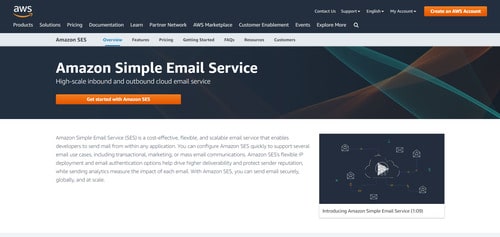
Amazon SES is the email service offered by Amazon Web Services (AWS). Users can independently use SES services for email without subscribing to other AWS services. The Amazon SES mail server can be used to send and receive email. It does not include IMAP or POP servers. Developers will have to set up services like the Amazon S3 bucket to store incoming emails.
Key features:
- Robust documentation, libraries, and ecosystem support.
- Tools and features to increase deliverability. Keeps track of recently bounced emails as part of the global suppression list.
- Ability to create a custom analytics setup.
- Works extremely well with applications hosted on AWS.
Cost:
The charge for sending emails is $ 0.10 per 1,000 emails. The first 62,000 emails are free for applications hosted on Amazon EC2 or Amazon Lambda. In addition, users have to pay $ 0.12 for each GB of attachments sent and $ 0.10 per 1,000 emails received.
In addition to these services, there are addon services for:
- Dedicated IP addresses - $24.95 per month
- Bring Your Own IP Addresses (BYOIP) - $24.95 per month for each IP address
- Deliverability dashboard - $1,250 per month
More details about Amazon SES pricing are available on the pricing webpage.
2. SMTP.com
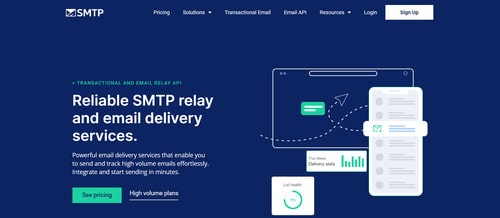
SMTP.com offers email delivery services to entities that have high email volumes, mainly transactional emails. It’s a complete email delivery suite for marketers and developers that includes transactional emails, email relay, and email deliverability.
Key features:
- Scalable and easy-to-use.
- Strong API support that developers can make use of.
- Track and analyze large email volumes.
- Turnkey migration from other services.
- Custom API integrations available.
Cost:
The pricing plans start at $25 per month for 50,000 emails and go up to $500 per month for one million emails. There are minor differences in the features included in the different plans. Businesses that require even higher volume or custom features can request a quote at their website.
3. Mailchimp Transactional Email
Mailchimp is a leading and widely recognized email marketing service provider. The transactional email service, formerly known as Mandrill, is built on Amazon SES for better accessibility for end-users. Even non-developers can easily access and use their offering.
Key features:
- Ability to send personalized transactional emails with high deliverability.
- Customizable analytics dashboards and export APIs.
- White labeling Mailchimp Transactional is possible.
- Globally distributed infrastructure to support fast delivery.
- Ready-to-go transactional email templates are available.
Cost:
First-time customers can send 500 emails for free. The pricing starts at $20 per month for 25,000 emails and goes up from there according to email volume. There is a $29.95 fee per month if dedicated IP is required. You can key in the expected email volume and get the corresponding price at the MailChimp website.
4. Mailgun
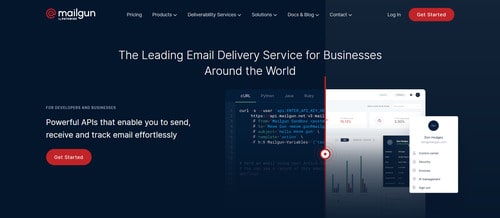
Mailgun is an email service that focuses on developers, with APIs to send and receive emails. Mailgun’s API-first development methodology focuses on simplicity and compliance to standards, making life easier for developers who want to use and customize the services.
Key features:
- Built for developers with an API-first development approach focused on usability.
- 99.99% uptime SLA ensures high reliability of the service.
- Fast and accurate email validation service.
Cost:
Mailgun offers 5,000 free emails per month for the first three months. Beyond that, there is a pay-as-you-go payment structure that charges you for only the services you use. There are also fixed price tiers that start at $35 per month for 50,000 emails. Enterprise services are also available, and you can reach out to Mailgun for a quote.
5. Postmark

Postmark is an email service that can be easily integrated with existing applications. They also have a robust service for transactional emails along with email API, SMTP, and other messaging services.
Key features:
- Fast delivery is ensured by distributed infrastructure.
- Detailed analytics including click, open, and link tracking.
- Accessible documentation is available on the website.
- Migration guides for easy migration from other services.
Cost:
A free trial of the service is available on sign-up. Pricing starts at $1.25 per email for the first 10,000 emails, and the rates per email considerably reduce as the volume goes up. Detailed pricing is available on their pricing page.
6. Twilio SendGrid
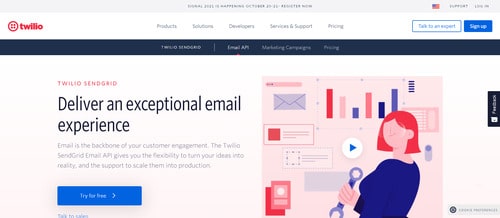
SendGrid is one of the most popular email services. It was acquired by Twilio and became a sub brand of the service, now known as Twilio SendGrid. Developers can use the SendGrid API to integrate the service with their application in a very short time.
Key features:
- Easy to read and customizable console.
- Integration tools and resources provided by SendGrid.
- High email deliverability with sender authentication, SPF and DKIM, reverse DNS and dedicated IP addresses.
- Highly scalable.
Cost:
There is a free trial that can be used to send 100 emails/day. Pricing plans start from $14.95 for 50,000 emails per month and go up from there. There are many add-on services to choose from according to the pricing tiers.
7. SparkPost
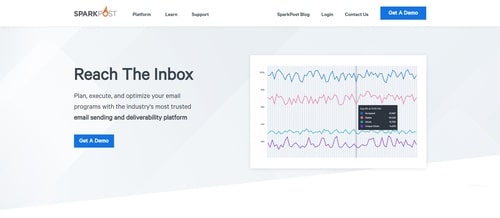
SparkPost is a fully integrated email service that can be planned, executed, and optimized from a single console. SparkPost maintains a robust security and compliance posture to meet the needs of customers in highly regulated industries.
Key features:
- Powered by the industry’s largest data network.
- Guaranteed 99.99% uptime guaranteed by the SLA.
- Plenty of flexible email templates are available.
- Recipient validation, inbox tracker, and analytics support.
Cost:
Prospective customers can schedule a demo of the service with the team. The free tier of the service can be used to send 100 emails per day. Beyond the free service, multiple pricing tiers are available with different features starting from $20 per month.
8. Netcore Email API (formerly Pepipost)
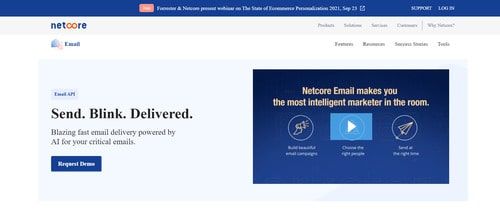
Pepipost was acquired by Netcore to become a part of its cloud services portfolio. Netcore Email API offers fast email delivery powered by artificial intelligence.
Key features:
- Fast integration with applications using SMTP or RESTful APIs.
- Email health analytics included with the service.
- Homegrown MTA powered by AI to ensure fast delivery with high deliverability.
Cost:
Prospective customers can request a demo at their website. Contact the team directly for custom price quotes.
9. SMTP2Go
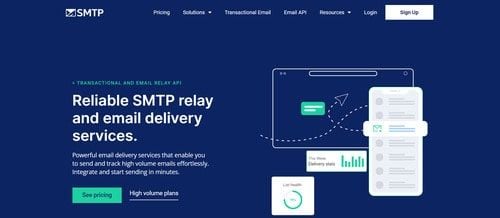
SMTP2Go offers powerful email delivery and tracking services for developers. Their service ensures that emails reach the inbox and do not end up in the spam folder.
Key features:
- Visual reports to gain a fast overview of email statistics.
- Multi datacenter approach to reduce the downtime to near zero.
- Testing option to test emails against major spam filters.
Cost:
Free tier available on signup even without submitting credit card information. This can be used to send up to 1,000 emails per month. Beyond that, services start at $10 per month to send up to 10,000 emails per month. Users can also create a custom plan and get a price quote from their pricing page.
10. Elastic Email
Elastic Email is an easy to use email service for both developers and marketers. Developers can easily connect and send emails at scale via Elastic Email’s HTTP API or SMTP relay.
Key features:
- Can be easily scaled to send more than 100 million emails per month.
- Robust REST API with extensive documentation.
- Easy integrations and email automation.
Cost:
Users can send unlimited emails to 5,000 contacts at $15 per month. Separate pricing plans are available for Email marketing and Email API access at their respective web pages.
11. SocketLabs
SocketLabs offers SMTP or API access to easily set up high-volume transactional emails. A trustworthy email service provider, SocketLabs combines intelligent technology and human expertise to create a high delivery mail service.
Key features:
- Advanced analytics and reporting.
- Hurricane MTA technology for safe and reliable email delivery.
- Tailored solutions can be packaged for prospective clients.
Cost:
A free trial of the service is available on signup. Users can send up to 2,000 emails per month for free forever. A free trial offers 40,000 free emails for the first month. There are many plans to choose from their signup page.
12. Oracle Cloud Infrastructure Email Delivery
Oracle is one of the largest cloud infrastructure providers. Their infrastructure can be used to send fast and reliable emails to a large number of recipients.
Key features:
- Unique mailbox provider SMTP configurations on Mail Transfer Agents (MTA).
- Email authentication standards to reduce failed delivery.
- Suppression list keeps track of undeliverable email addresses across Oracle infrastructure.
Cost:
Oracle email delivery can be accessed along with other products from their ecosystem Reach out to Oracle for a price quote.
13. Mailjet
Mailjet is a service from Pathwire with a focus on transactional emails. Marketers can create beautiful-looking transactional emails to be delivered to customers. Developers can make use of the Mailjet infrastructure to build a fast-sending pipeline via API calls.
Key features:
- SMTP Relay or Send API can be used to send automated transactional emails.
- Comprehensive API features with extensive documentation.
- Easy email tracking and analytics made possible by using webhooks.
Cost:
A free tier is available for users that includes up to 6,000 emails per month at a rate of 200 emails per day. Paid plans start at $15 per month for 15,000 emails. This can be scaled to large volumes. Reach out to Mailjet for a custom price quote.
14. JangoSMTP
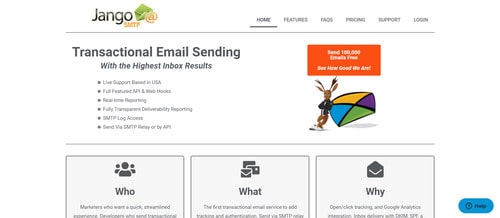
JangoSMTP is a transactional email service with live tracking and strong API support. The service can be used by both marketers and developers for a streamlined integration experience.
Key features:
- Email tracking and authentication are standard parts of the service.
- Inbox delivery with DKIM, SPF, and dedicated IP addresses.
- Custom tracking domain for better sending reputation and branding.
Cost:
The service can be used to send 100,000 emails as part of a trial after signing up. Paid plans start from $25 per month for 8,500 emails per month.
15. Kingmailer SMTP
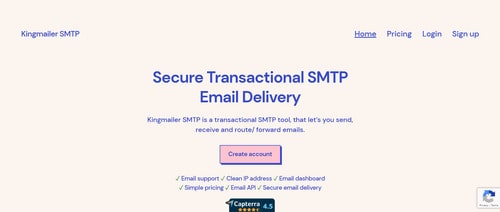
Kingmailer SMTP can be used to send, receive, and route emails. They offer secure transactional SMTP email delivery with a very high success rate.
Key features:
- The service only uses clean IP addresses to send emails.
- Email API is available for developers to build custom email services.
- Fast setup and easy integration possible.
Cost:
A 14-day free trial of the service is available after signup. 20,000 emails can be sent to any number of recipients at $11.95 per month. You can also email the sales team for a custom pricing plan. Kingmailer SMTP accepts almost all prominent cryptocurrencies as payment.
16. Doppler Relay
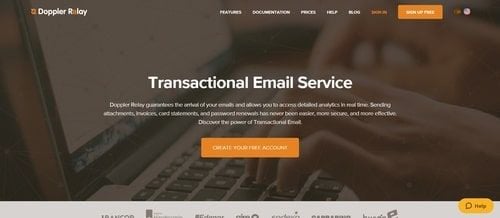
Doppler Relay is a transactional email service that offers three ways to send transactional emails: SMTP, API, and FTP. The company claims a delivery rate of more than 98%, which is a good number for email delivery.
Key features:
- SMTP, API, and FTP are used to send large volumes of transactional emails simultaneously.
- Create templates for different types of transactional emails.
- Ability to set up automated processes for high deliverability.
- Strong support for analytics and detailed reporting.
Cost:
A free trial of the service is available on signup. Paid plans range from $26.50 per month for 50,000 emails to $1,960 per month for 5 million emails.
17. MailerSend
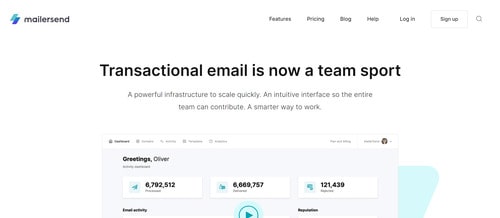
MailerSend offers a powerful and highly scalable infrastructure to send large volumes of transactional emails. It also provides a platform where teams can collaborate to plan, design, build, execute, and optimize transactional emails.
Key features:
- RESTful API with official libraries and extensive documentation.
- Routing feature for incoming emails.
- Automated personalization of transactional emails.
- Pre-designed email templates.
- Drag and drop builder for email creation.
Cost:
Any user can sign up to send up to 12,000 emails every month. Beyond the free limit, the cost is $1 per 1,000 emails. Fixed paid plans start from $25 for 50,000 emails per month.
18. CloudMailin
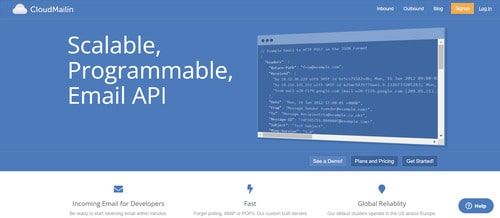
CloudMailin offers scalable, programmable APIs for developers. The company offers both inbound and outbound email services with SMTP integration for easy setup.
Key features:
- Clusters operated in the U.S. and Europe for high reliability.
- Highly scalable with email parsing HTTP Webhook server.
- Works with any language or framework.
- Complete history of all email transactions and reports is stored for 30 days.
Cost:
CloudMailin has a free tier that can be used to send up to 10,000 emails per month. All paid plans have a trial period of seven days. Paid plans start at $25 per month.
19. GreenArrow
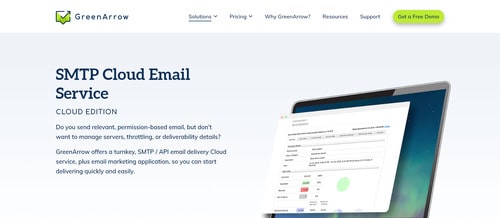
GreenArrow can be used to send large volumes of emails. It is easily accessible for both developers and marketers. With GreenArrow, you can send relevant, permission-based emails without managing servers or other delivery metrics. The service also has an on-premise solution.
Key features:
- Email injection through SMTP or HTTP API.
- Encrypted email delivery enhances the safety of messages.
- Strong tracking, analytics support, and engagement management are possible from a single dashboard.
Cost:
Pricing starts at $250 per month for 300,000 emails and goes up from there, based on the number of emails and add-on features. The on-premises solution offers three pricing tiers starting at $600 per month.
20. Critsend
Critsend is a dedicated email service offering high deliverability and a globally distributed sending infrastructure. The platform is built and supported by veterans with years of experience related to email services.
Key features:
- Spam folder placement detection alerts you if an email was sent to the spam folder.
- Globally distributed infrastructure for fast delivery.
- Custom PF, DKIM, machine, tracking domain available for users.
Cost:
Critsend has a pay-as-you-go pricing model. There is no time limit within which users have to use the allocated number of emails. The plans range from $50 for 100,000 emails to $3,000 for 10 million emails.
21. Flowmailer

Flowmailer is a service that can be used to send large volumes of transactional emails without losing sight of a single email. The platform is built and supported by a team of specialists in transactional email. It can be seamlessly integrated with any application with email API or regular SMTP.
Key features:
- Fully GDPR compliant email service that’s ISO 27001 certified.
- Real-time tracking, analytics, and reports to gain useful insights.
- Advanced built-in templates that are readable from any device.
- Full control over bounce management.
Cost:
Flowmailer has custom pricing tiers according to the number of emails and features. Pricing starts at €89 to send 25,000 emails every month.
22. LeaderSend

LeaderSend manages email infrastructure that developers and marketers can use on a pay-as-you-go pricing structure. All types of transactional emails are supported by the service.
Key features:
- Personalized DKIM, SPF, Feedback Loops.
- Reputation and ISP monitoring handled by LeaderSend.
- Real-time reporting for easy decision-making.
- Built-in templates that can be easily modified.
Cost:
Pricing depends on the email delivery rate and the number of emails. The delivery speed tiers are:
- Bronze (200 emails/hour)
- Silver (2,000 emails/hour)
- Gold (Unlimited emails/hour)
The price is $10 for 50,000 emails at bronze delivery rate. It goes up to $2,000 for 5 million emails at the gold delivery rate.
23. Maildocker

Maildocker is an email service that offers both behavioral and transactional email delivery. The service is easy to use for developers, companies, beginners, and professionals alike. The service is powered by RESTful API and can also be implemented with easy SMTP integration.
Key features:
- Strong tracking features with complete visibility over emails.
- Built-in templates that can be customized with variables, constants, and conditions.
- Use of docklets to work like completely independent systems.
- Event-based marketing automation can be set up easily, even without developer help.
Cost:
The service starts at $24.95 for 100,000 emails per month. The price tiers go up to $199 for 1 million emails. Beyond that, you’ll need to request a custom quote from Maildocker. There is an additional monthly fee of $29.95 for a dedicated IP address.
24. OhMySMTP
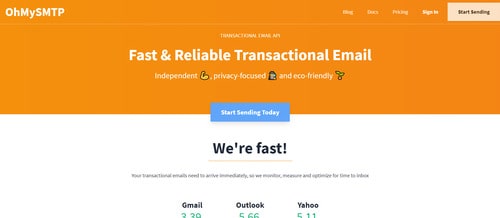
OhMySMTP provides privacy-focused transactional email delivery. Focusing exclusively on transactional emails, OhMySMTP does not mix emails with bulky marketing emails, so your emails are less likely to end up in the spam folder.
Key features:
- The infrastructure uses 100% carbon-neutral, renewable energy-powered servers.
- Enforced DKIM validation to actively remove spammers and automatically check all outbound emails for spam.
- Uses local hosting and does not rely on cloud infrastructure.
- Delivery acceptance tracking.
Cost:
The service starts from $3.33 for 1,000 emails per month. The next tier is priced at $1 per 1,000 emails. For a custom quote, you can reach out to the team from the pricing page.
25. Sarv TES
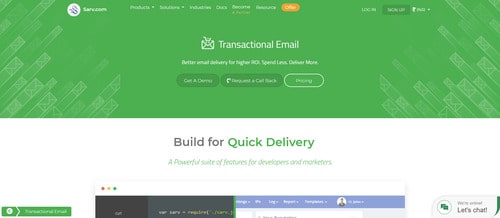
Sarv TES (Transactional Email Service) is an email delivery platform that can be used by both developers and marketers. The platform is set up for quick email delivery, even with large volumes.
Key features:
- Powerful API for developers.
- A visual dashboard that can be used by marketers.
- Real-time access to statistics like opens, clicks, bounces, emails delivered, and complaints.
- Available as a white-labeled product.
Cost:
Sarv TES offers its service based on a pay-as-you-go pricing structure. The base plan will cost around $ 0.08 to $ 0.14 per 1,000 emails. The service also has pricing options that have a fixed number of emails for a fixed subscription fee. Details of their pricing can be viewed on the SarvTES pricing webpage.
26. turboSMTP
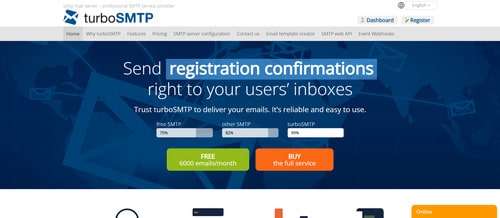
TurboSMTP is an email service with high deliverability that can be relied on for sending large volumes of transactional emails. It is easy to use for both marketers and developers.
Key features:
- Developers can use the email API from the service to bake email delivery into the applications they are building.
- Trusted and authenticated SMTP relay service ensuring high deliverability.
- Regular activities reporting, real-time clicks, and open tracking.
Cost:
The service can be used for free for a period of 12 months. Each month, users on the free plan can send 6,000 emails at a rate of 200 emails per day. The basic plan starts at $14.95 per month to send 50,000 emails. Enterprise users can reach out to TurboSMTP for a custom quote.
27. UniOne Email API
UniOne Email API
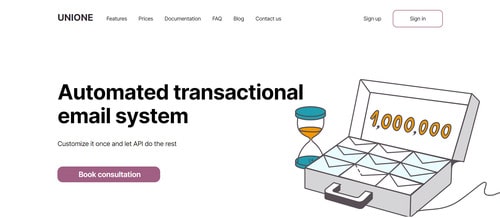
UniOne API can be used to send a large volume of emails at a fast pace, scaling up to 5 million emails per hour. The service is developer-friendly as well as marketer-friendly.
Key features:
- 99.8% deliverability.
- Easy and fast integration with a Web API or SMTP connection.
- The API can be customized to send automated transnational emails.
Cost:
The service has a free tier to send 6,000 emails every month. The next tier is for $6 per month to send 10,000 emails. There is an additional charge of $ 0.75 per 1,000 emails. Detailed pricing can be seen in the ‘prices’ section of UniOne’s website.
28. Ongage
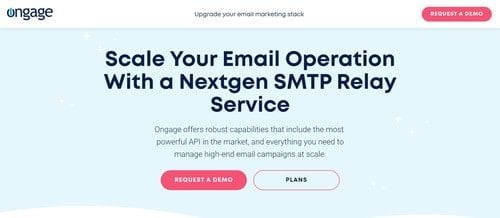
Ongage is an easily scalable email service with SMTP relays and a powerful API. The service has dedicated tools for marketers with an intuitive user interface.
Key features:
- Easy for non-developers to create custom email templates and set up real-time A/B testing.
- The recipient list can be segmented and used for targeting users that share similar demographics.
- Completely automated, tailored, and personalized emails can be sent with easy setup.
Cost:
Ongage requires a minimum volume of 250,000 emails per month. Contact the Ongage team for a quote.
29. Retarus
Retarus is a leading platform for all messaging-related activities for any business. They have a dedicated service for transactional emails and promises high-performance emails with high deliverability.
Key features:
- CSA-compliant email rendering.
- The service is supported with multi-interface architecture.
- Efficient IP routing using sender domain.
- Global suppression list to keep track of undeliverable email addresses.
- Reputation management with SPF, DKIM, DMARC.
Cost:
Request a quote from the Retarus team by submitting the contact form.
30. Coresender
Coresender uses in-cloud SMTP servers and APIs with reputable IP addresses to send transactional emails. This ensures a high delivery rate.
Key features:
- The delivery rate of the service is 99.91%.
- Takes less than 5 seconds to reach the inbox of the recipient.
- Aggregated statistics and message timelines using real-time webhooks.
- Easy SMTP server integration.
Cost:
There is a free trial available on signup. A credit card is not required to use the free trial. The paid plans start at $25 for 50,000 emails per month and go up to $350 for 1 million emails per month.
31. JetSend

Jetsend provides transactional email services that can be integrated with other applications using APIs or SMTP. The flexible system provides a customizable integration approach for sending transactional emails.
Key features:
- Support for multiple programming languages.
- Dedicated IP addresses for every user to send emails.
- Robust suite of tools to track and monitor statistics related to the emails sent.
Cost:
Jetsend offers 3,000 emails per month for free. Free users can send up to 100 emails per day. Paid tiers start from $8 to send 10,000 emails per month and goes up to $629 for 1.5 million emails per month. There is an additional charge of $70 per month for a dedicated IP address.
32. AuthSMTP
AuthSMTP is a global outgoing SMTP email service used to send a high volume of emails. It can be integrated with e-commerce websites or any application for fast email delivery.
Key features:
- Secure emails with SSL options.
- Multiple tier 1 network connections for enhanced reliability.
- Online Control Panel, as well as email and web based support.
Cost:
AuthSMTP has a detailed pricing page where users can select their requirements and get an instant quote.
33. Postage APP
Postage APP offers an email API for transactional emails that can be easily integrated with any application. The service is built with developers in mind. It’s easy to use and quick to set up.
Key features:
- Clean and simple integration with JSON-based API.
- Plugins available for various languages.
- Hosting for custom HTML and CSS templates.
Cost:
Pricing starts at $9 for 10,000 emails per month. It goes up to $399 for 1 million emails per month. Quotes for custom plans can be obtained by directly emailing the team.
34. Moesif
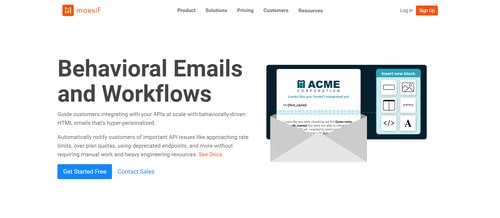
Moesif creates APIs that can be used for behavioral emails and automated workflows. Developers can completely automate the process of sending customer notifications for various scenarios with Moesif.
Key features:
- Behavior-based customer targeting.
- No sending restrictions for custom emails.
- Hyperscaling is possible as and when required.
- Built to leverage other email services like Amazon SES or SendGrid.
Cost:
The service has a trial period of 14 days for every plan. There is also a free tier where users can send up to 30,000 emails per month. The paid plans are $85 and $495 per month to send 1 million and 5 million emails per month, respectively.
Your app or business has unique needs, so the best transactional email service for your needs might not be the one that suits another business.
Comparing the features, capabilities, and pricing of the 35 transactional email services above will help you make an informed decision. Once you’ve implemented a transactional email service, supercharge your email notifications with MagicBell's transactional email API, which provides a unified interface to providers like SendGrid, Mailgun, and Amazon SES, and gives your users a notification center with MagicBell's embeddable notification inbox.